
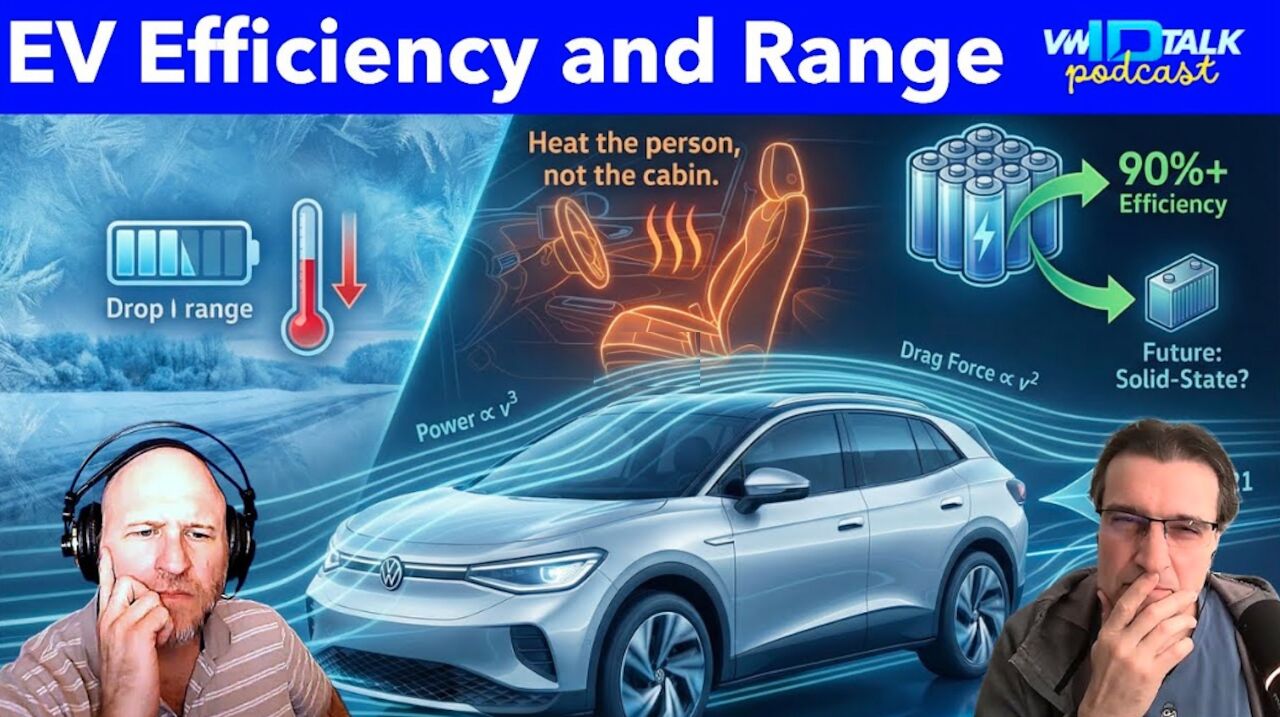
Why is your EV so efficient on paper, but loses range at high speeds or in winter? We walk through the physics of drag, battery vs fuel energy, heating losses, and what you can do to stretch every kWh in your EVs.
The TTAC Creators Series tells stories and amplifies creators from all corners of the car world, including culture, dealerships, collections, modified builds and more.
This video originally posted about a year ago; however, it’s information is relevant as EV owners and potential buyers head into colder weather. A transcript, summarized by AI and edited by a staffer, is below.
[Image: YouTube Screenshot]
Become a TTAC insider. Get the latest news, features, TTAC takes, and everything else that gets to the truth about cars first by subscribing to our newsletter.
Summary
The VW ID Talk podcast examines the science behind electric vehicle (EV) efficiency, explaining why EVs are significantly more energy-efficient than gasoline-powered vehicles, what limits their driving range, and how drivers can maximize efficiency. The discussion focuses on three primary subjects: energy efficiency, battery energy density, and aerodynamics, followed by an explanation of how EVs consume energy in different driving conditions.
1. EVs Are Significantly More Energy-Efficient
One of the biggest takeaways is that electric vehicles are considerably more efficient at converting stored energy into motion than internal combustion engine (ICE) vehicles.
- EVs operate at greater than 90% efficiency, meaning most of the energy stored in their batteries goes toward powering the vehicle.
- Gasoline-powered vehicles operate at approximately 30% to 40% efficiency. The remaining 60% to 70% of the energy is largely lost as waste heat.
- As a result, an EV can travel approximately four times farther than a gasoline vehicle using an equivalent amount of energy, according to the podcast's comparison.
The hosts explain that gasoline vehicles benefit from their waste heat during colder weather because engine heat can be redirected into the passenger cabin. EVs don't have that luxury. They must use energy from their batteries to heat the cabin and maintain appropriate battery operating temperatures.
2. Gasoline Has a Major Advantage in Energy Density
Although EVs are more efficient, gasoline has a substantial advantage when it comes to storing energy. The hosts compare a Volkswagen Golf with a 13-gallon (approximately 50-liter) gasoline tank against a Volkswagen ID.4 with a fully charged battery.
The Golf's gasoline tank contains approximately 500 kWh of energy, while the ID.4's battery stores roughly 77 kWh. That means the gasoline vehicle carries considerably more stored energy, even though it uses that energy much less efficiently.
The discussion suggests that if an EV could store the equivalent amount of energy found in a gasoline tank while maintaining its current efficiency, its driving range could be extraordinary.
The hosts point to solid-state batteries and other emerging battery technologies as potential solutions to the energy-density limitations currently restricting EV range. The central distinction: EVs aren't less efficient because they have shorter driving ranges. Their limitation is that today's batteries cannot store nearly as much energy per unit of weight and volume as gasoline.
3. Aerodynamics and Drag Are Critical to EV Efficiency
Because electric motors are already highly efficient, automakers must look elsewhere for meaningful improvements in energy consumption. Aerodynamics is one of the biggest opportunities.
The podcast explains that every vehicle encounters aerodynamic drag as it moves through the air. The amount of resistance increases dramatically with speed.
Two important relationships are discussed:
- Aerodynamic drag force increases with the square of vehicle speed.
- The power required to overcome aerodynamic drag increases with the cube of vehicle speed.
In practical terms, doubling a vehicle's speed increases aerodynamic drag force fourfold and the power required to overcome that drag eightfold.
This explains why highway speeds can have such a substantial effect on EV driving range.
The hosts also explain two important aerodynamic variables:
Frontal area: The amount of the vehicle's front-facing surface exposed to the airflow. Larger vehicles generally have greater frontal areas, making them more difficult to push through the air.
Coefficient of drag (Cd): A measurement of how effectively a vehicle moves through the air. Lower numbers indicate better aerodynamic performance and less resistance.
Automakers have greater control over the drag coefficient through vehicle design, while frontal area is largely dictated by the vehicle's size and body style.
Comparing aerodynamic performance
The podcast provides several examples of drag coefficients:
| Vehicle | Approximate drag coefficient |
| Typical SUV | 0.38 |
| Volkswagen ID.4 | 0.28 |
| Hyundai Ioniq 5 | Approximately 0.29 |
| Mercedes-Benz EQS | 0.20 |
| Hyundai Ioniq 6 | 0.21 |
| Audi A6 e-tron | 0.21 |
| Older Audi A4 sedan | Approximately 0.27 |
One particularly interesting comparison involves the Volkswagen ID. Buzz. Despite its boxy appearance and substantial frontal area, its drag coefficient is reportedly close to that of the ID.4.
The problem with the ID. Buzz isn't necessarily how efficiently it moves through the air relative to its shape, but rather how much air it must push aside.
The hosts also point out that EV aerodynamic improvements are benefiting gasoline-powered vehicles. Design techniques developed for electric vehicles can be applied to conventional vehicles, improving their efficiency as well.
4. Driving Speed Has a Major Impact on Range
The relationship between speed and aerodynamic drag makes driving habits particularly important for EV owners.
Because the power needed to overcome aerodynamic resistance increases with the cube of speed, relatively small increases in highway speed can result in substantial increases in energy consumption.
The hosts recommend driving approximately 60 to 65 mph rather than 75 mph when conditions allow.
EVs are generally more efficient at lower speeds for two reasons:
- Aerodynamic drag is less significant at lower speeds.
- Regenerative braking allows EVs to recover energy during stop-and-go driving.
This helps explain why conventional gasoline vehicles typically achieve better fuel economy on the highway, while hybrids and EVs can benefit significantly from city driving.
The Toyota Prius is offered as an example of how hybrid systems use electric power at lower speeds and rely more heavily on the gasoline engine at highway speeds.
5. Cold Weather Can Significantly Reduce EV Range
Another major topic is how energy consumption changes during colder weather.
The hosts present an energy-consumption breakdown for an EV operating in a cold climate.
Cold-weather energy consumption
- Propulsion: Approximately 50% of energy consumption.
- Heating: Approximately 20% to 30% of energy consumption.
- The remaining energy is used by other vehicle systems and accessories.
Unlike gasoline vehicles, which generate substantial waste heat, EVs must draw electricity from their batteries to heat the passenger compartment and maintain battery temperatures.
This can produce a significant reduction in driving range, particularly when temperatures fall below approximately 40 degrees Fahrenheit.
The Volkswagen ID.4 is used as an example. Its cabin heater can draw up to approximately 6 kW, while the battery heater can consume another 5 kW under certain conditions.
The hosts explain that these systems don't necessarily operate at maximum output continuously, but their combined energy requirements can be substantial.
For example, consuming 10 kWh during an hour of heating represents approximately 13% of a 77-kWh battery's capacity.
Cold temperatures also affect battery performance. The battery management system can restrict power output to protect the battery from potential damage associated with operating at low temperatures.
6. Heat Pumps and Other Ways to Improve Winter Efficiency
The podcast discusses heat pumps as a more efficient alternative to conventional electric heating systems.
A heat pump can use approximately 1 kWh of electricity to generate as much as 3 kWh of heat, making it considerably more efficient than traditional resistive heating.
However, the hosts note that a heat pump isn't available on the U.S.-market Volkswagen ID.4 discussed in the episode.
They also offer several practical suggestions for reducing winter energy consumption:
- Precondition the battery: If possible, heat the battery while the vehicle is connected to a Level 2 charger. This draws energy from the electrical grid rather than the battery.
- Use heated seats: Heating the occupants directly requires less energy than warming the entire cabin.
- Use the heated steering wheel: Like heated seats, this provides localized warmth without requiring the entire passenger compartment to be heated.
- Reduce cabin temperature: Keeping the cabin slightly cooler while using heated seats and steering-wheel heating can help conserve energy.
The hosts emphasize that drivers don't need to sacrifice comfort unnecessarily, particularly when charging infrastructure and available range aren't concerns.
They also note that air conditioning during warmer weather uses battery power, but its energy requirements generally aren't as significant as winter heating demands.
7. Key Takeaways
The podcast concludes with three major lessons about EV efficiency.
First, electric vehicles are substantially more efficient than gasoline vehicles. Their shorter driving ranges aren't the result of inefficient propulsion systems. Rather, the limiting factor is the amount of energy current batteries can store compared with gasoline.
Second, aerodynamics and driving speed are especially important. Because aerodynamic power requirements increase with the cube of speed, reducing highway speeds can meaningfully improve driving range. Automakers also have considerable opportunities to improve efficiency through aerodynamic design.
Third, cold weather creates additional energy demands. Heating the cabin and battery can consume a substantial portion of available battery capacity. Preconditioning, heat pumps, heated seats and heated steering wheels can help reduce that impact.
The episode also previews a future discussion about regenerative braking and how EVs recover energy during deceleration.
Bottom Line
The most interesting point in this discussion is that EV range limitations are fundamentally a battery-storage problem rather than an efficiency problem.
Electric motors already convert stored energy into motion far more effectively than gasoline engines. The challenge is developing batteries that can store significantly more energy without adding excessive weight, cost or volume.
In the meantime, aerodynamics, driving speed and temperature management remain three of the biggest factors determining how far an EV can travel on a charge.


